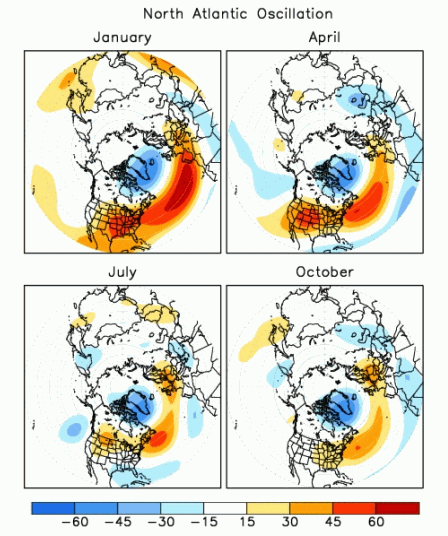
One of the most common winter questions is whether large-scale indices
like the North Atlantic Oscillation (NAO) can tell us something
meaningful about local snowfall. The chart below compares NAO values
with snowfall at NRFK, and while the relationship is often assumed to be
strong, the data tells a different story.

The regression line slopes slightly negative, but the fit is extremely
weak—NAO explains only about 1% of the snowfall variability in this
dataset. Big snow events occur during negative, neutral, and even positive NAO
phases. In short, NAO alone does not control snowfall totals here.
Why This Matters Right Now
This becomes especially relevant when looking at the current pattern,
which has featured:
- Periods of blocking or
near-blocking signals
- Fluctuations between negative
and neutral NAO
- A generally active but
inconsistent storm track
It’s tempting in setups like this to assume that a negative or
trending-negative NAO automatically favors significant snowfall. But this
dataset shows that assumption doesn’t hold up well on its own.
Forecast Takeaway: What the NAO Can
Tell Us in This Pattern
In the current regime, NAO is useful for context, not conclusions.
A negative or neutral NAO can suggest:
- Slower or more amplified flow
- Increased chances for cold air to
linger
- A background environment that can
support wintry outcomes
But it does not guarantee:
- That storms will track favorably
- That cold air arrives at the
right time
- That precipitation intensity
overlaps with sub-freezing thermals
Those details are being driven right now by shortwave timing, phasing,
and thermal profiles, not by the NAO index itself.
Why Snowfall Still Comes Down to
Storm-Scale Details
Looking at the current setup, snowfall outcomes will hinge on:
- Whether individual waves phase or
shear out
- How far north warm air intrudes
ahead of systems
- The placement of deformation
zones and banding
- Boundary-layer temperatures
during peak precipitation
All of those factors can overwhelm whatever background signal the NAO is
providing.
Bottom Line for the Current Pattern
This analysis reinforces a critical forecasting lesson:
The NAO can help frame the pattern—but it won’t solve the snowfall
forecast.
Even in a block-leaning or colder-looking regime, snowfall remains a storm-by-storm
problem. The best forecasts right now will come from focusing on:
- Synoptic evolution inside 5–7
days
- Thermal structure and
precipitation timing
- High-resolution guidance as
events approach
NAO may help explain why the pattern looks the way it does—but it
won’t tell you how much snow is going to fall.


No comments:
Post a Comment